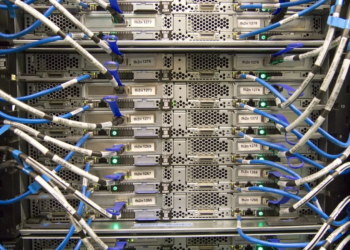


Apple is developing enterprise AI servers built around future M8 Ultra chips, and this time the plan is to sell the machines rather than keep them in-house. The project, first reported by The Information, would give Apple its first server hardware to reach the market in close to two decades, and it has backing from new Apple CEO John Ternus, who championed the effort a year ago while still leading Apple’s hardware engineering group, according to Ars Technica.
The Apple AI servers are aimed squarely at the AI inference market, where companies run trained models rather than train new ones. That is a narrower job than the training clusters Nvidia and AMD sell into, and it plays to what Apple’s Ultra chips already do well in the Mac Studio: a lot of unified memory bandwidth per chip, at lower power draw than a rack of discrete GPUs.
Two chip configurations, one open networking question
Two versions are reportedly in development: one with two M8 Ultra chips, another with four. Both are still years out, apple’s Ultra chips have shipped as a fused pair of Max dies since the M1 generation, so a four-chip box would need a new way to stitch the packages together at server scale. Apple is said to be weighing Nvidia’s NVLink Fusion for that interconnect job, which would be notable given how rarely Apple licenses a competitor’s core plumbing into its own silicon roadmap.
No release date is locked in, and the reporting points to no earlier than 2029. That gives Apple time to get M8 Ultra into shipping Macs first, since the Ultra tier historically lags the standard M-series by a year or more, and to decide whether NVLink Fusion is worth the dependency.
What’s driving demand for Apple AI servers
The push follows a run-up in sales of the Mac Studio and Mac mini among AI developers and companies running inference workloads on Apple silicon instead of GPUs, drawn by the memory-per-watt trade-off rather than raw throughput. An enterprise server would let Apple sell that same trade-off in a rack-mountable form instead of leaving buyers to cluster consumer desktops, which is what some AI shops have reportedly been doing already.
How this compares with the Nvidia superchip workstations already shipping
We covered MSI’s XpertStation WS300 last month, a workstation built around Nvidia’s GB300 superchip that started shipping in August. That machine is available now and runs on Nvidia’s own compute and interconnect stack end to end. Apple’s approach is closer to the opposite bet: its own silicon for compute, with Nvidia’s networking tech considered only as a connector between Apple’s chips, not as the processor doing the inference work. It also will not ship for years, against a product Nvidia’s partners are already selling.
That contrast is the real story here: Apple is not chasing Nvidia’s GPU business, it is trying to carve an inference-only lane next to it, using a chip families that already exist in the Mac lineup rather than something built from scratch for servers.
What to watch
Three things will decide whether this ships as described: whether Apple keeps the 2029 timeline once M8 Ultra actually lands in Macs, whether it commits to NVLink Fusion or builds its own chip-to-chip interconnect instead, and whether Ternus keeps sponsoring the project now that he runs the whole company rather than just hardware engineering.