
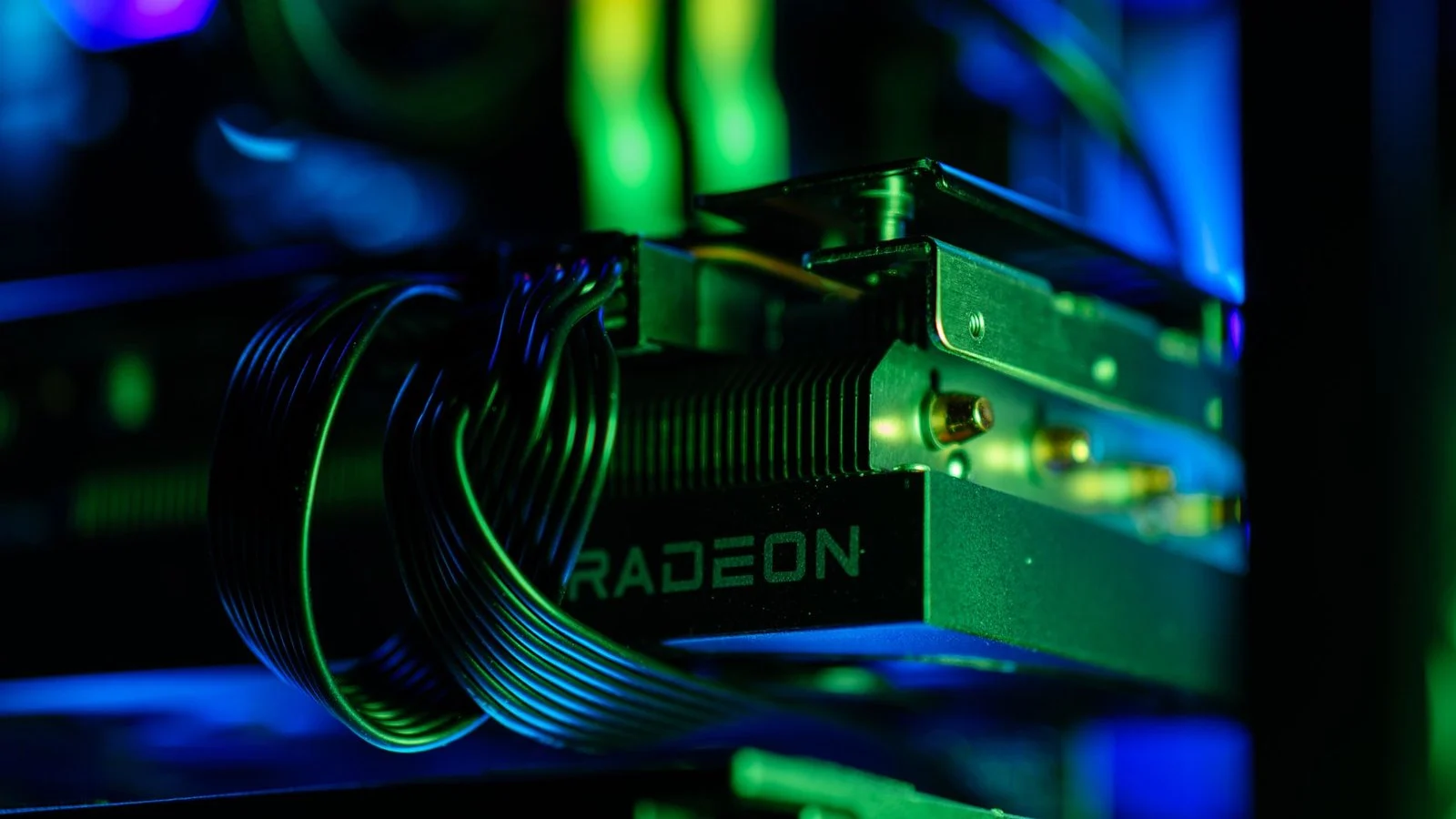
A modder has ported Nvidia’s DLSS 5 neural rendering to AMD GPUs for the first time, less than a week after the technology started spreading to older GeForce cards. Developer danielblnc’s tool, DLSS-NR-on-AMD, is the first working example of DLSS 5 AMD GPU support, running on Radeon RX 9000-series cards built on RDNA 4. It works, but the Radeon RX 9070 XT still can’t hold 30 FPS at 1080p in Cyberpunk 2077 with the feature switched on.
How the wrapper gets DLSS 5 onto RDNA 4
The install is a small installer plus Nvidia’s own nvngx_dlssnr.dll dropped into a game’s bin folder, then neural rendering is toggled on through an existing FSR 3 or FSR 4 profile. The project is closed-source, so the exact mechanism isn’t public, but the wrapper appears to intercept Nvidia’s NGX API calls and let the DLSS 5 DLL load on AMD hardware regardless. Once loaded, it pulls the AI model and tensor data out of that DLL and converts the calculations into a form AMD’s matrix accelerators can run, through the HIP RT backend rather than a CUDA translation layer, then hooks the result into the game’s FSR pipeline.
None of this would be possible without a hardware coincidence: DLSS 5 runs on FP8 math, and RDNA 4, the architecture behind the RX 9000 series, has native FP8 support, the same as Nvidia’s RTX 40 and 50-series cards. It has been tested so far on Cyberpunk 2077 and GTA V: Enhanced, with older AMD GPUs not supported. Anti-cheat will block the DLL outright, so this stays single-player territory for now.
The frame rate figures don’t tell one story
This is where the coverage is worth reading carefully rather than repeating. Early builds reportedly dropped Cyberpunk 2077 from over 80 FPS natively to just 11 to 12 FPS at 1080p on the RX 9070 XT, footage that traces back to YouTuber Ancient Gameplays.
The modder’s own Alpha v0.2.7 changelog claims a roughly 12% improvement on top of that, landing around 30 FPS, with a further update said to add about 2% more. That 12% describes the mod’s own prior build, not the 11 to 12 FPS shown in the independent capture, so the changelog percentage and the actual on-screen drop describe two different starting points. For a card that renders Cyberpunk 2077 natively above 80 FPS, 30 FPS with the feature on is still a steep cost, whichever number is used as the baseline.
What to watch next
The eventual goal, per Tom’s Hardware, is performance closer to an RTX 5070 Ti, a card matched with the RX 9070 XT in rasterisation and close in ray tracing, which the outlet notes isn’t far-fetched given how similar the two GPUs already are.
Getting there means optimising a wrapper with no access to Tensor cores, running entirely on general-purpose matrix math instead. Nvidia has RTX 40-series DLSS 5 support planned, and more games are due to add the feature beyond NBA 2K27 and the two titles this mod currently supports. We covered the toll DLSS 5 already takes on Nvidia’s own hardware in our look at RTX 5090 laptop frame rates; the difference now is that the same neural rendering model is being forced onto silicon Nvidia never built it for, at a steeper cost still.
Anyone wanting to try it can grab the tool from danielblnc’s GitHub page, bearing in mind it currently supports only two games and no online play.