
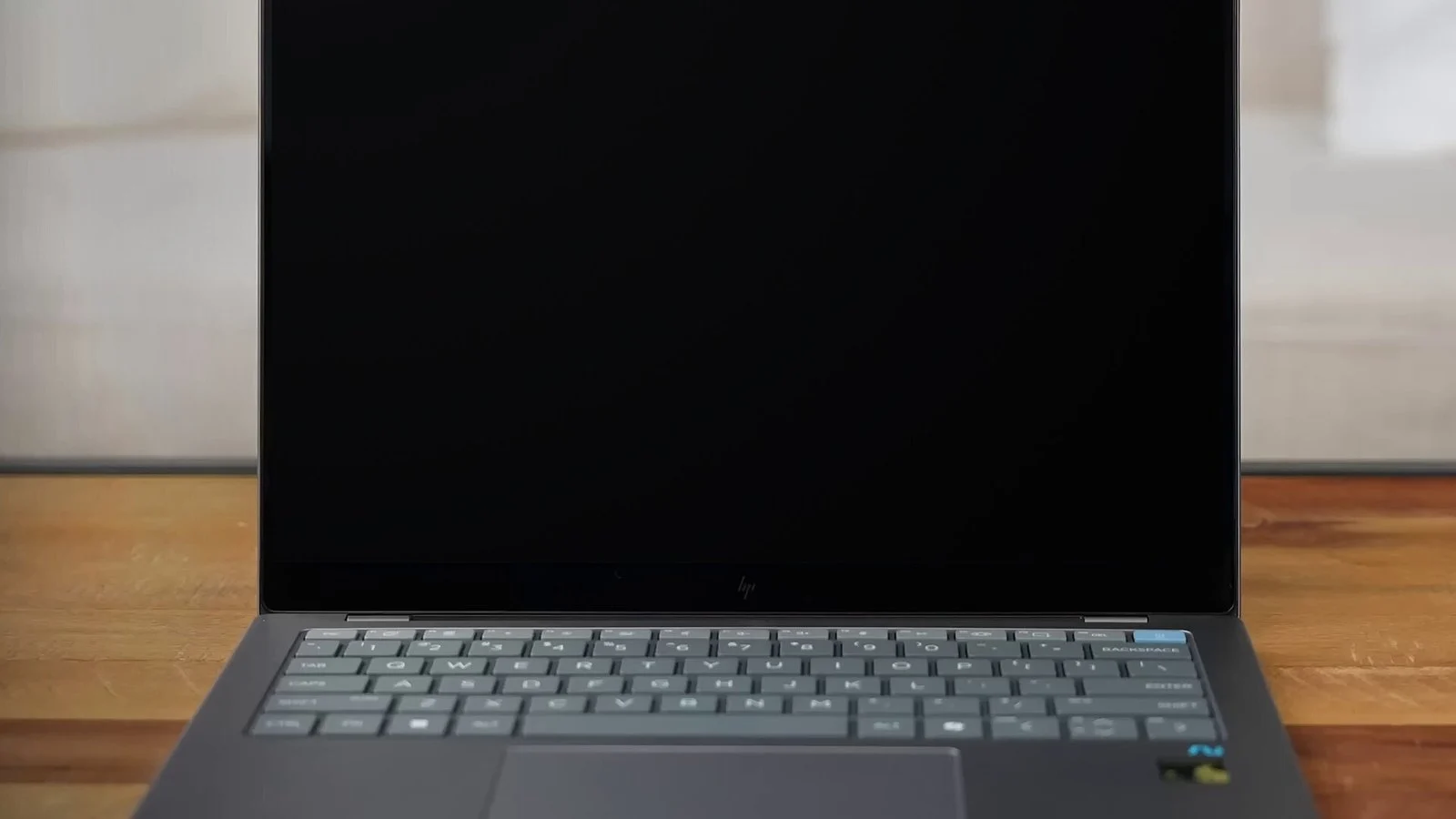
HP has announced the HP Googlebook 14, its first laptop in the category, combining Qualcomm’s Snapdragon X Elite chip with a 14-inch 3K OLED touchscreen inside a chassis just 10.91mm thick. Guru3D, which broke the specs, reports the machine is due in the US in October, with pricing starting at $1,199.
Inside the HP Googlebook 14: OLED, Oryon and a thin chassis
The Snapdragon X Elite is Qualcomm’s Oryon-based Arm chip line, built to compete with Intel and AMD on power efficiency rather than raw clock speed; Arm-native code runs directly, while legacy x86 software runs through emulation. Pairing it with an OLED panel reinforces that priority, since OLED only draws power for pixels that aren’t black, so consumption tracks what’s actually on screen rather than a fixed backlight draw. The “3K” label is a naming convention rather than a fixed spec: it generally covers panels with a horizontal resolution in the low 3,000s, sitting between 1440p and 4K in the laptop displays most enthusiasts compare it against.
Why a vapor chamber fits a 10.91mm chassis
Heat pipes need a minimum diameter to move useful heat, and there isn’t much room for that inside a notebook this thin. A vapor chamber is a flat, sealed plate that spreads heat across a wider surface than a round pipe can reach, which is why it turns up in chassis too thin to route pipes to a corner-mounted fan. That doesn’t automatically mean there’s a fan in here: some Snapdragon X Elite designs use a vapor chamber purely for passive cooling, and HP hasn’t said which this is. What the part confirms is that heat needs spreading across more of the chassis than a pipe or two could manage at this thickness, however it ends up being exhausted.
The Googlebook category gets a second chipmaker
HP’s entry is worth placing next to what’s already shipped under the same branding. Lenovo’s earlier Googlebook was built around MediaTek’s Dimensity CX C10 Max, a completely different silicon platform. A 14-inch Snapdragon X Elite model gives the category a second chip family to draw on, which matters to anyone weighing an Arm-based Googlebook against the MediaTek version already on sale: the two won’t behave the same under sustained load, and buyers comparing them are really comparing Qualcomm’s and MediaTek’s efficiency curves as much as the laptops built around them.
What to watch
HP hasn’t detailed memory or storage tiers beyond the $1,199 starting price, so the full configuration range should surface as the October US launch approaches. Given the vapor chamber, sustained performance under load, rather than the usual Snapdragon X Elite battery-life pitch, is the number worth checking once independent reviews land.
Image: Booredatwork.com via Wikimedia Commons, licensed under CC BY 3.0.