

Lenovo has started selling a new Panther Lake desktop PC in the US, the ThinkCentre X AIO Aura Edition, an all-in-one built around Intel’s mobile silicon and fitted with a display shaped for stacking windows vertically rather than spreading them across a wide screen.
A Panther Lake desktop PC with a different display
Lenovo hasn’t published exact panel dimensions, resolution or brightness figures for the new all-in-one, only that the layout favours vertical multitasking: stacking a browser, a document and a chat window on top of each other instead of side by side. That’s a departure from the ultrawide and standard 16:9 panels most all-in-ones ship with, and it points to Lenovo treating the AIO Aura Edition as a desk-bound productivity screen rather than a media display.
The chip inside is a mobile Panther Lake part, soldered rather than socketed. Intel’s actual desktop CPU line is a separate track: the company has already confirmed the LGA1954 socket for its upcoming Nova Lake-S desktop chips, which will ship as conventional pluggable processors rather than the laptop-derived silicon powering the ThinkCentre X AIO.
Other Panther Lake machines landing alongside it
The ThinkCentre X AIO isn’t the only new Panther Lake machine to reach the US this week. Lenovo also released the ThinkPad X13 Detachable, a Surface Pro 12 rival with a 13-inch 3:2 display running at 120Hz, 32GB of RAM and a total weight of 2.76 lbs including its keyboard folio.
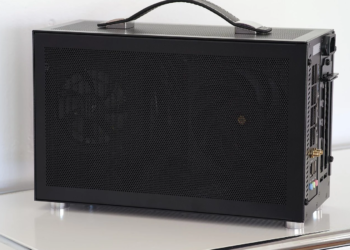
Acer, separately, introduced the Veriton RI110, a compact machine it calls an AI Mini Workstation. It pairs the Core Ultra X7 358H with Intel’s Arc B390 graphics, up to 96GB of LPDDR5X memory and up to 4TB of PCIe Gen 4 storage, and adds an OCuLink port for attaching an external GPU dock or AI accelerator, a connector Liliputing was alone in flagging. It’s the same Core Ultra X7 358H and Arc B390 combination we covered just over a week ago in the Minisforum M2 Pro, now arriving in a second vendor’s chassis.
Vendor framing versus independent reporting
Acer’s own announcement, republished by TechPowerUp and marked as a press release, leans on the phrase “hybrid agentic AI workloads” and states that the RI110 can support AI models of up to 120 billion parameters. That figure comes from Acer, not from an independent benchmark, and it depends heavily on how a model is quantised and split across the iGPU, the NPU and whatever OCuLink accelerator is attached. It’s also the same “agentic AI” branding Intel applied to its forthcoming Diamond Rapids server chips a little over a week earlier, now redeployed for a machine that fits under a monitor.
Liliputing’s and Notebookcheck’s coverage, by contrast, stuck to the parts list: the chip, the RAM ceiling, the OCuLink port, the panel refresh rate. By our arithmetic, Notebookcheck’s report on the Lenovo desktop went live 16.2 hours before Acer’s press release reached TechPowerUp, a reminder that this Panther Lake launch wave is arriving from at least two OEMs on staggered schedules rather than as one coordinated announcement.
What to watch
The open question is whether Acer’s 120-billion-parameter claim holds up once independent reviewers run local inference on RI110 units rather than repeating the press release. The same applies to Lenovo’s vertical display: neither company has published resolution or brightness figures yet, and that’s the detail that will decide whether the format is genuinely useful or just unusual.