
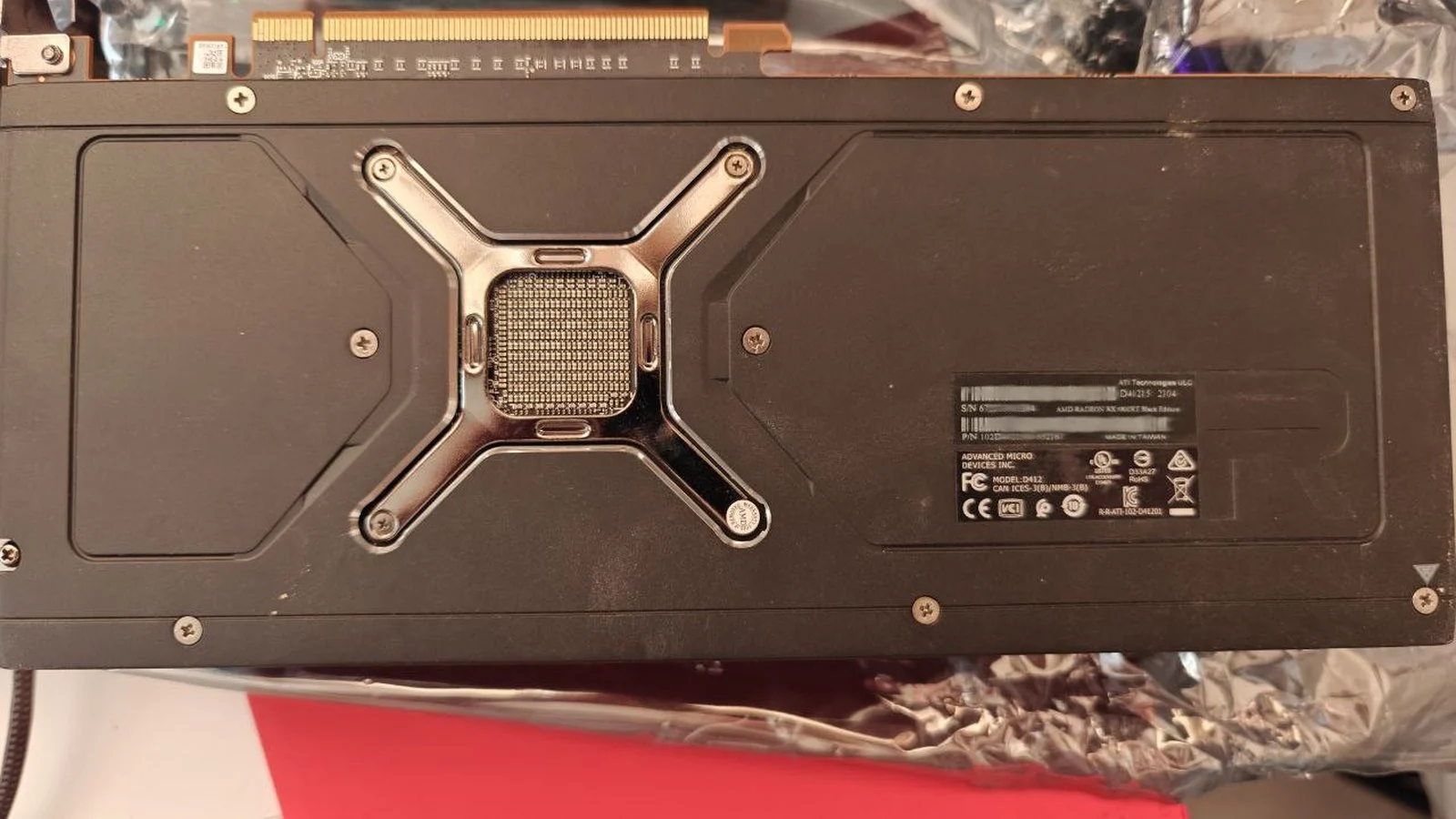
AMD has confirmed that the 4GB Radeon RX 9050 carries a narrower memory bus, less bandwidth and half the Infinity Cache of the 8GB model, despite both cards sharing the same Navi 44 die. The detail comes from an update to AMD’s own product documentation, which spells out exactly how much the cheaper Radeon RX 9050 4GB configuration gives up against its 8GB sibling.
Radeon RX 9050 4GB specs against the 8GB card
Both versions of the entry-level RDNA 4 card use 1,024 Stream Processors spread across 16 Compute Units and can boost to 2.6GHz. Past that, the specs diverge. The 8GB card runs 8GB of GDDR6 on a 128-bit bus for 288GB/s of bandwidth, with 32MB of Infinity Cache on the die. The 4GB card is cut to a 64-bit bus, which drops bandwidth to 144GB/s, and gets only 16MB of Infinity Cache, according to figures TechPowerUp pulled from AMD’s updated documentation.
That Infinity Cache figure is the part AMD hadn’t previously made clear. The original listing for the 4GB card didn’t call out any difference in cache size next to the 8GB model, leaving buyers to assume the two shared the same 32MB block. AMD’s documentation now confirms the 4GB card only gets half that amount, a change that matters more than the memory bus on its own: Infinity Cache absorbs traffic that would otherwise hit the narrower, slower bus, so a smaller cache compounds the bandwidth cut rather than offsetting it.
The cuts land at exactly half, not a partial trim
By our arithmetic, every spec AMD reduced for the 4GB card was reduced by precisely 50 percent: memory capacity (4GB against 8GB), bus width (64-bit against 128-bit), bandwidth (144GB/s against 288GB/s) and Infinity Cache (16MB against 32MB). AMD didn’t keep the wider bus while trimming cache, or the reverse; every figure that moved, moved by the same ratio. That kind of symmetry usually points to a single die with memory controllers and cache blocks disabled in matching pairs, rather than two physically distinct configurations built for their own price points.
Shader count, Compute Units and boost clock stay untouched, so the 4GB card isn’t a cut-down GPU in the traditional sense of fewer execution units. It’s the same processing hardware fed by a narrower, slower, smaller-cached memory subsystem, which is exactly the kind of change that shows up hardest in workloads that don’t fit inside a small cache, like higher-resolution textures or ray tracing passes.
Where the 4GB card fits
AMD already has driver support in place: the Adrenalin 26.8.1 driver update added Radeon RX 9050 4GB support ahead of this documentation confirming the memory-subsystem cuts. That suggests AMD sees the 4GB card as a shipping product rather than a placeholder SKU, aimed at the same budget segment its 8GB sibling already covers with headroom to spare.
Neither outlet has published independent benchmarks isolating what the narrower bus and smaller cache cost in frame rate, so the practical gap between the two cards is still unmeasured. That’s the number worth watching for once review hardware reaches outlets: whether the 4GB card’s memory cuts show up mainly at higher resolutions, or drag down performance across the board.
Image: Vitaly Zdanevich via Wikimedia Commons, licensed under CC BY-SA 4.0.