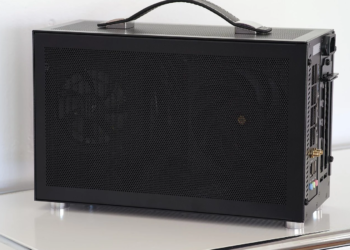

Acemagic used its IFA 2026 booth to confirm the specifications behind the F9A, the mini workstation it first showed off running AMD’s Ryzen AI Max+ PRO 495 chip, code-named Gorgon Halo. The show runs from 4 to 8 September at Messe Berlin, and Acemagic’s stand, Booth 128 in Hall 6.2, is one of several pushing the same silicon into compact desktops built for running large language models locally rather than in the cloud.
We covered Acemagic’s F9A when it first appeared without confirmed clock speeds or a chassis size. Both have since surfaced, along with a rival machine from Minisforum built on the exact same chip.
Inside the Ryzen AI Max+ PRO 495 chassis
The F9A ships in a two-litre chassis measuring 158.5 x 158.5 x 81.5mm, a tight footprint for what AMD positions as its top-tier Ryzen AI Max+ PRO 495 APU. Inside is a 16-core, 32-thread Zen 5 CPU that AMD rates for boost clocks up to 5.2GHz, paired with integrated Radeon 8065S graphics that handle both display output and the on-chip AI acceleration.
Memory is the number that matters most for anyone planning to run models locally: TechPowerUp’s hands-on at the show lists support for up to 192GB of LPDDR5X running at 8,533 MT/s. That’s enough unified memory to keep larger open-weight models resident without swapping to disk, which is the pitch behind AMD’s whole Ryzen AI Max+ line.
That approach differs from a conventional desktop, where a discrete GPU’s VRAM caps how large a model can run entirely on-card; regardless of how much system RAM sits alongside it, memory that isn’t on the graphics card is off-limits to CUDA-class inference. AMD’s Ryzen AI Max+ platform instead lets the CPU, NPU and integrated GPU draw from one shared pool, which is why the memory ceiling matters more here than the core count.
Minisforum ships the same silicon
Acemagic isn’t alone in putting the Ryzen AI Max+ PRO 495 to work this week. Minisforum announced two machines on the same processor: the MS-S1 MAX-P495 mini workstation and the AI Agent NAS N5 MAX-P495, a networked-storage box built to run AI agents rather than just serve files. Both are quoted at up to 131 TOPS of AI compute, a figure from AMD rather than an independent benchmark, and both top out at 192GB of memory running at the same 8,533 MT/s.
Minisforum’s spec sheet also caps how much of that memory the GPU can claim: up to 160GB of the 192GB total can be allocated as graphics memory. By our arithmetic, that leaves 32GB for the operating system and background tasks when the allocation is maxed out, a reserve equal to 20 percent of the graphics slice itself. Anyone buying into these unified-memory machines for local AI work should plan around that split rather than assuming the full 192GB is usable by a model.
What to watch next
Neither Acemagic nor Minisforum has published pricing or availability for these machines, and that’s unlikely to change before IFA closes on 8 September. Watch for retail listings once the show wraps: AMD’s Ryzen AI Max+ PRO 495 is new enough that early pricing will decide whether these mini workstations undercut a conventional desktop with a discrete GPU or end up costing about the same.