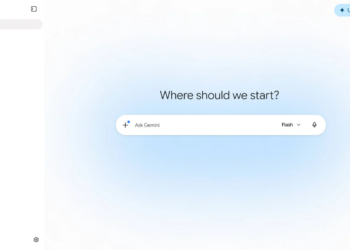


Google released Gemini 3.8 Flash on Wednesday, three weeks after Gemini 3.7 Flash. The model ships in two forms: a standard “workhorse” version aimed at agentic tasks and software development, and Gemini 3.8 Flash Cyber, tuned specifically for vulnerability detection and mitigation rather than general-purpose coding. Full details are in Google’s announcement.
What Gemini 3.8 Flash changes
Google says the new model works harder than its predecessor by running more reasoning steps on complex tasks and calling tools iteratively rather than in a single pass. Google frames that as thoroughness for harder problems, not raw speed. That extra effort has a cost: Google warns the model may burn through more tokens to reach that performance, particularly at higher effort settings, and developers who want to keep usage down can stick with Gemini 3.7 Flash instead.
Pricing stays where 3.7 Flash left it, for now. API access is available at an introductory rate through the end of the year: $0.75 per million input tokens and $3.75 per million output tokens. Regular pricing returns to $1.50 per million input tokens once the introductory window closes, the same shift Google applied when 3.7 Flash launched.
Why Google keeps shipping Flash instead of Pro
The pace is unusual even by Google’s standards, and it comes while the company’s frontier ambitions look shakier than the release cadence suggests. Gemini 3.5 Pro was promised for June and never arrived, and Google DeepMind CEO Demis Hassabis stepped down in early August, moving to chairman while Koray Kavukcuoglu took over research leadership with the lesser title of SVP. Gemini 3.5 Flash, meanwhile, has been outscored on intelligence benchmarks by open-weight models out of China. Flash updates are the one lever Google can still pull quickly, and it has been pulling it roughly every three weeks.
Nobody agrees on the count
Ask how many Flash models Google has shipped this year and the answer depends on where you start counting. 9to5Google calls Gemini 3.8 Flash the third Flash update in three months. Ars Technica counts it as the third in six weeks. The Register puts it at the fourth Flash model in as many months. By teqpost’s arithmetic, all three are technically correct: they are just anchoring to different releases in a run of models that has arrived faster than anyone has settled on how to describe it.
The blurred count is itself the story: a cadence fast enough that outlets covering the same announcement can’t agree on the tally is not a cadence built around a coherent roadmap. It looks more like Google filling the gap left by a delayed Pro release with whatever Flash iteration is ready, similar to how Anthropic has adjusted Claude Code usage limits on short notice rather than committing to a fixed schedule. For readers trying to track Google’s frontier roadmap, that ambiguity is the more useful signal than any single benchmark number.
What to watch
The open question is still Gemini 3.5 Pro, or whatever frontier model eventually replaces the promise of it. Until that arrives, expect the Flash line to keep absorbing Google’s improvements, and expect the pricing to keep shifting: 3.7 Flash saw the same introductory-to-regular jump 3.8 Flash is now offering, and that pattern will likely repeat again whenever 3.9 Flash shows up.