
Intel’s chief technology and operations officer says the company’s 14A node should land within 5% of TSMC’s competing A14 process, a forecast that raises more questions than it settles, because Intel has not said which side of that 5% it expects to land on.
The figure comes from Naga Chandrasekaran, who is also general manager of Intel Foundry, in a conversation with investment bank KeyBanc Capital Markets. “Within 5%” could mean 14A ships faster than TSMC’s A14, or 5% slower. Those are very different outcomes for anyone deciding which foundry to book capacity with, and Intel’s own language does not resolve it either way.
What “within 5%” leaves open for Intel’s 14A node
Part of the problem is that “performance” is not one number. It can mean transistor switching frequency, power efficiency at a given frequency, or transistor density, and a single-digit gap in one of those does not imply the same gap in the others. Intel’s recent process generations, including the now-shipping 18A, have tended to trail TSMC’s nodes on transistor density while staying competitive on performance and power. That pattern traces back to Intel’s historic focus on CPU clock speed over raw density, a bias its own fabs can afford to carry because Intel absorbs the cost of a larger die rather than paying a fabless customer’s per-wafer premium for it.
The clock-speed comparison Tom’s Hardware ran
Tom’s Hardware lined up shipping chips from both camps’ current nodes to see whether that pattern still holds. Intel’s Core Ultra X9 388H “Panther Lake”, built on 18A, hits a peak of 5.10GHz at an 80W maximum turbo power. On TSMC’s N2, AMD’s EPYC 9586F reaches 5.0GHz at a 500W default CPU power, Apple’s A20 Pro hits 4.93GHz, and Apple’s M6 tops out at 4.78GHz.
None of that converts cleanly into a single “X% faster” verdict, since the four chips use different architectures, voltages, standard-cell libraries and thermal envelopes. But by our arithmetic, teqpost calculates that Panther Lake‘s 5.10GHz peak sits 6.7% above the M6’s 4.78GHz, the widest gap in the set, and it favours Intel’s process rather than TSMC’s. That is the opposite of the density story, and it is the actual evidence behind Intel’s insistence that 18A already competes on frequency. It also means a “within 5%” 14A that lands on the wrong side of that gap would be a step backward, not a wash.
Intel’s targets and timeline for 14A
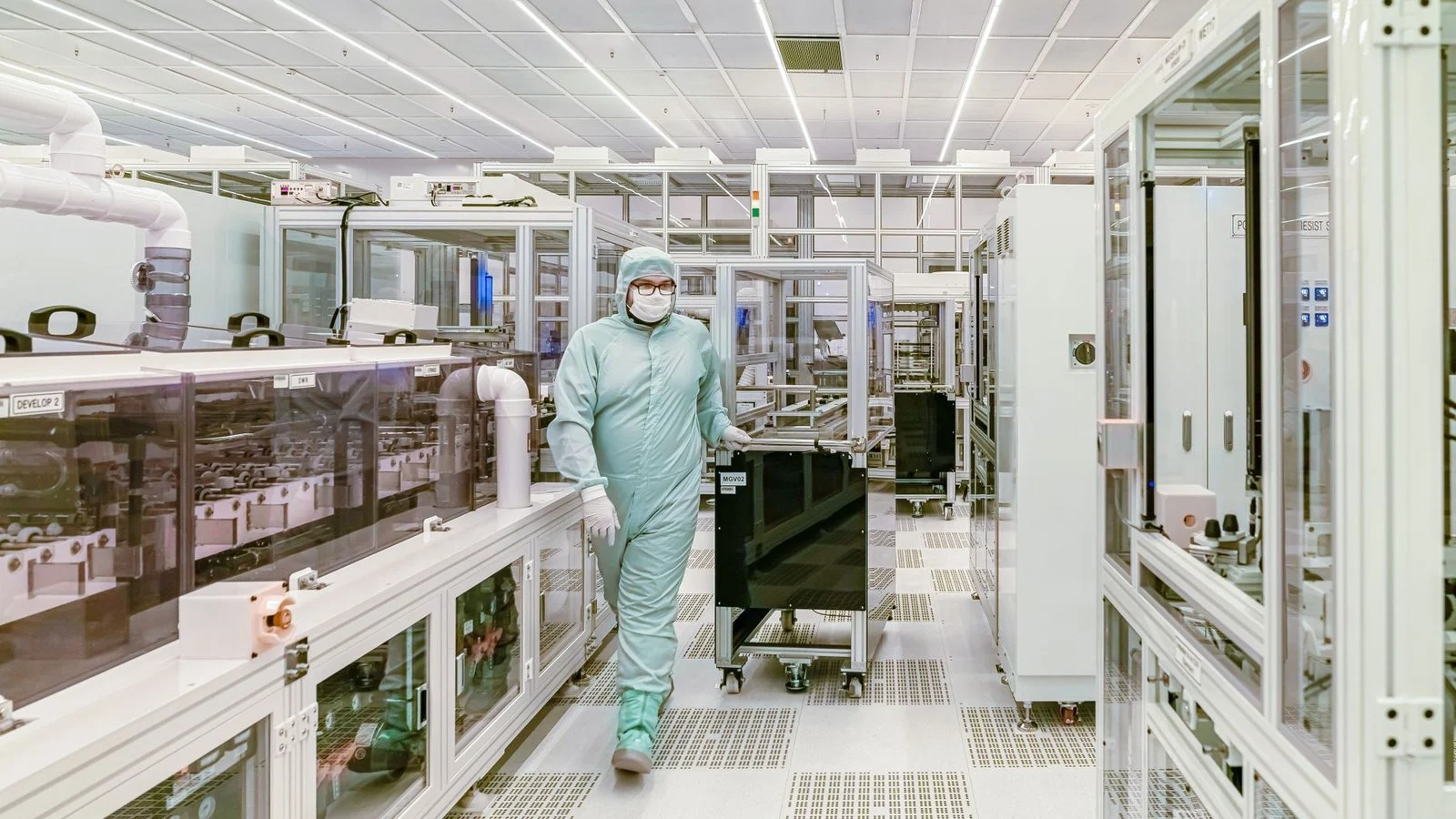
Intel is not shipping 14A yet. The company plans to start risk production in the second half of 2027, with high-volume manufacturing following in 2028. Tens of thousands of 14A wafers have already gone through pilot production runs, and Intel says it is now working through yield improvements and minor node adjustments before that risk-production milestone.
On paper, 14A is designed to deliver 15 to 20% more performance at the same power as 18A, or, tuned the other way, a 25 to 35% power reduction at matched performance, alongside up to a 30% improvement in chip density over 18A. TechPowerUp, which also covered the KeyBanc briefing, notes that Intel has not clarified whether that density figure describes logic scaling or SRAM scaling, and SRAM has been the harder of the two for the whole industry to shrink in recent generations.
What to watch
The real test of the “within 5%” claim will not arrive until Intel actually has 14A silicon running against production TSMC A14 parts, which on Intel’s own schedule is still at least two years out, starting with risk production in the second half of 2027. Until then, the frequency data from today’s 18A and N2 chips is the closest thing to an independent read on how the two companies’ processes actually compare.