
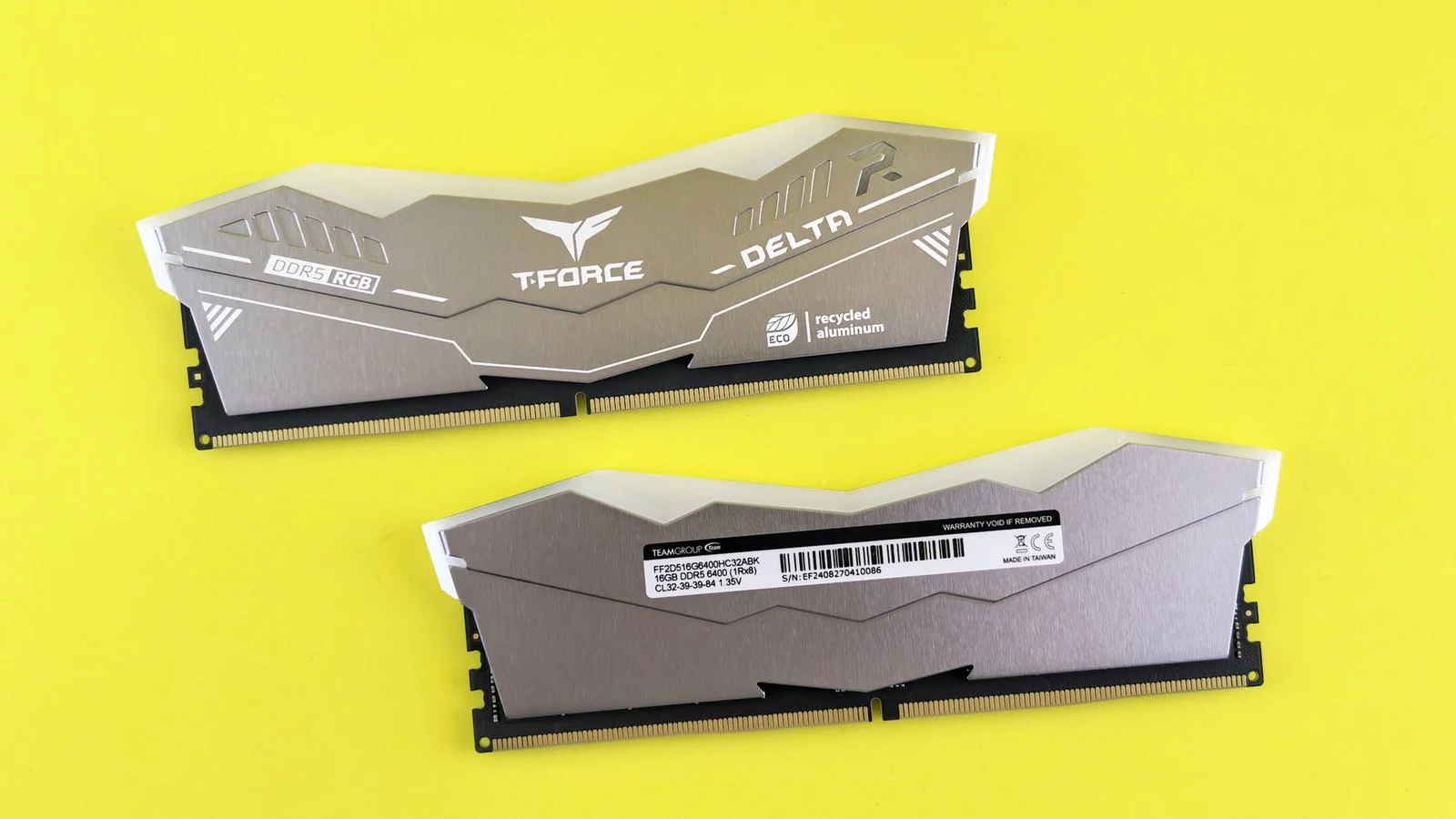
DDR5 memory prices have risen 416% over the past year, according to Tom’s Hardware, and a 128GB DDR5-6400 kit now sells for $3,399 against a lowest-ever tracked price of $329, ten times the record low. Those are two different measures and the outlet keeps them apart: 416% is year on year, the tenfold figure is against the all-time floor. The outlet says the market is “divorced from reality”, and its price history for every other capacity it tracks backs that up: nothing sold in the past year has come close to its previous floor.
DDR5 memory prices climb faster than DDR4
Tom’s Hardware’s tracker shows the same pattern across the board: DDR5-5200 16GB has gone from a low of $52 to $239, DDR5-5600 32GB from $72 to $394, DDR5-6000 64GB from $159 to $849, and DDR5-6000 96GB from $189 to $1,799. PCPartPicker’s average pricing for August 2025 to August 2026 tells the same story from a different angle: a 6000 MT/s 2x32GB kit went from $222 to $1,272, up 473%, and a 5600 MT/s 2x32GB kit from $191 to $1,118, up 485%.
By our arithmetic, across the six DDR5 tiers Tom’s Hardware cites from PCPartPicker, the average year-on-year increase is 416%. Across the six DDR4 tiers over the same period it is 157%: DDR5 has risen 2.6 times faster than DDR4. That gap is why buyers have been scrambling for older DDR4 platforms as a workaround, which has itself pushed a 2x32GB DDR4-3200 kit up 177%, from $222 to $614. Stepping down to DDR4 no longer means stepping outside the price spiral, only into a smaller one, and for anyone building or upgrading a system now, that math is the whole decision.
What’s driving the memory shortage
Tom’s Hardware reports that hyperscale buyers, the cloud operators building out AI data centres, have locked in almost all global DRAM production capacity for 2027 and are paying advance deposits to secure it. Mainstream DRAM chips are now worth over half as much per kilogram as solid gold, and all four memory vendors, SK hynix, Samsung, Micron and China’s CXMT, have seen revenue jump by double, triple or more in a single year. Part of the squeeze is structural: High Bandwidth Memory, the stacked DRAM used in AI accelerators, requires many individual layers per chip, so the same wafer input now yields radically fewer standard memory chips.
SK Hynix chief executive Kwak Noh-jung has warned that 2027 will be the worst year for memory supply in the industry’s history, and expects demand to outstrip production well into 2030. ADATA chairman Simon Chen went further, suggesting the DRAM crisis could last another decade.
The pain isn’t confined to the US. Germany’s ComputerBase reports average European RAM prices up 345% against September 2025, with hard drive and SSD prices both climbing more than 125% over the same period. Even so, by our arithmetic the US squeeze has been the sharper one: the DDR5 average here is up 416% against Europe’s 345%.
What to watch
SK Hynix has already flagged 2027, not this year, as the low point for supply, and hyperscalers’ advance deposits mean that capacity is largely spoken for before it is even built. If Kwak Noh-jung’s demand forecast holds through 2030 and Simon Chen’s ten-year outlook is anywhere close to right, DDR5 kits are unlikely to return to anything like 2025 pricing on a timeframe worth waiting for.